
Mercy Ships: Illuminating its profound impact, navigating the controversies, and charting the future
AI-Powered Compassion: How Tech is Charting a New Course for Global Healthcare
Imagine a world where cutting-edge medical technology isn't confined to gleaming city hospitals, but floats across the ocean, bringing hope and healing to the most remote corners of the globe. That’s not a scene from a sci-fi movie, it’s the reality Mercy Ships is building, and honestly, when I think about it, it just takes my breath away.
Mercy Ships, with their two hospital ships, the Global Mercy and Africa Mercy, are already doing incredible work, delivering essential medical services to underserved populations. But what happens when you inject a dose of serious tech innovation into that mission? You get something truly revolutionary. Their partnership with Presidio and Cisco to modernize their IT infrastructure isn't just about faster internet; it's about reimagining how healthcare can be delivered, accessed, and improved on a global scale. Mercy Ships, Presidio and Cisco partner at the intersection technology and purpose - SiliconANGLE
This isn't your average IT upgrade. We're talking about a complete overhaul of the ships' networks, running almost entirely on Cisco equipment. Think about it: call-management VoIP systems, switches, switch stacks, and around 1,600 phones, all humming away to keep a floating city of over 800 people connected – medical staff, families, volunteers. It's like a small, self-contained world out there, and it needs a robust digital backbone to function.
The Floating Hospital of the Future
And here's where it gets really exciting: AI. Mercy Ships isn't just dipping their toes in the AI waters; they're diving in headfirst. They're already using AI for clinical work, like image classification in surgical tools and imaging systems. But they're not stopping there. They're exploring newer AI capabilities, like generative models, which could revolutionize everything from diagnosis to treatment planning. How incredible is that?
Now, I know what some of you might be thinking: "AI on a ship? Sounds complicated." And you're right, it is. Modernizing IT on a ship presents a unique set of challenges. Limited internet access, high latency, frequent outages, and the impact of metal walls on wireless coverage – it's a tech obstacle course. But that's where the ingenuity of this partnership shines. They're even considering Cisco IQ to optimize limited bandwidth from shore, providing visibility into asset inventory and using AI agents to analyze and resolve problems. It’s like giving the ship's IT team a super-powered assistant.
One of the biggest challenges is the fact that these ships are, essentially, floating cities. They're not just hospitals; they're also cruise liners, food service providers, and logistical hubs. The technology on board has to support all of that, and it has to do it reliably, even in the most remote locations. And this is why localizing compute on the ship is so vital. Cloud-based AI is fantastic, but it's not always reliable enough for patient care when you're thousands of miles from the nearest data center.
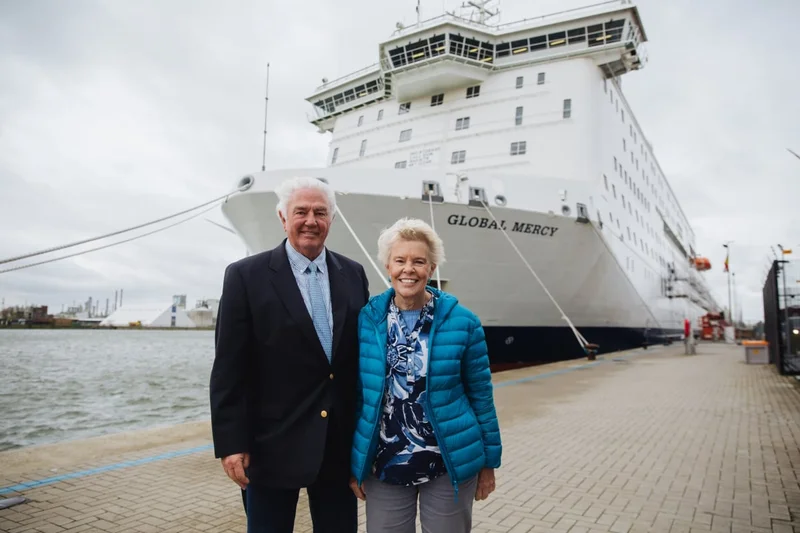
This reminds me of the early days of the printing press. Before Gutenberg, knowledge was scarce and controlled by a select few. The printing press democratized information, making it accessible to the masses. In the same way, Mercy Ships is democratizing healthcare, bringing advanced medical technology to people who would otherwise never have access to it. And the AI component? That's like adding a supercharger to the printing press, accelerating the spread of knowledge and improving the quality of care.
But with great power comes great responsibility. As we embrace AI in healthcare, we need to be mindful of the ethical implications. We need to ensure that these technologies are used to enhance human compassion, not replace it. We need to be vigilant about data privacy and security. And we need to make sure that everyone, regardless of their location or socioeconomic status, has access to the benefits of AI-powered healthcare.
Mercy Ships is also using Webex and other telepresence tools for remote consultations and training of local medical teams. This is huge. It means that even when the ship isn't physically present, its impact can still be felt. Local doctors and nurses can receive training and support from experts around the world, improving the quality of care long after the ship has sailed.
And let's not forget the Africa Mercy II, which is expected to enter service in 2028. This new ship will be even more technologically advanced, with even more capabilities to deliver life-saving medical care. The Global Mercy took nearly seven years to complete, partly due to the pandemic, which highlights the challenge of keeping technology up-to-date during long construction timelines. That's a crucial point – it underscores the need for constant innovation and adaptation in this field.
Humanity's Digital Lifeline
This partnership is about more than just technology; it's about people. It's about the doctors, nurses, and volunteers who dedicate their lives to serving others. It's about the patients who receive life-saving medical care. And it's about the potential of technology to make the world a better place. Mercy Ships isn’t just healing bodies; they’re mending the soul of humanity, one patient, one innovation, at a time. When I first read about the scope of the project, I honestly just felt a surge of pure, unadulterated hope.
I saw someone on Reddit comment the other day how this kind of tech could be a game-changer for remote communities. They wrote, "Imagine being able to get a diagnosis from a specialist thousands of miles away, just by walking to the local clinic." That's the kind of future we're talking about here.