
TMC Stock: Price & Latest Developments — What Reddit's Data Indicates
Okay, let's talk about The Metals Company (TMC). The stock's been on a rollercoaster, and everyone's got an opinion. But let's ditch the "vibes-based investing" and look at the data, shall we?
The October Surge and November Plunge
TMC saw a surge in October, hitting above $11. The narrative? Geopolitical tensions and the "critical minerals" buzz. Everyone was worried about supply chains, and suddenly, deep-sea mining looked like a quick fix. Then reality hit. By mid-November, the stock was below $5. Easing tensions, profit-taking – the usual suspects. Momentum shifted from panic to… well, cautious optimism. I saw a lot of chatter online, people trying to "buy the dip." But what's the real signal, and what's just noise?
Here's where it gets interesting. The stock has rebounded to $7.90 after Deutsche Bank (DB) hiked its gold price forecast. A gold price forecast impacting a deep-sea mining company focused on nickel, cobalt, copper, and manganese? Seems a bit… tangential, doesn't it? DB raised its 2026 gold prediction to US$4,450/oz, up from US$4,000/oz. That's a decent bump. But the real question is: how does this translate to TMC's actual prospects?
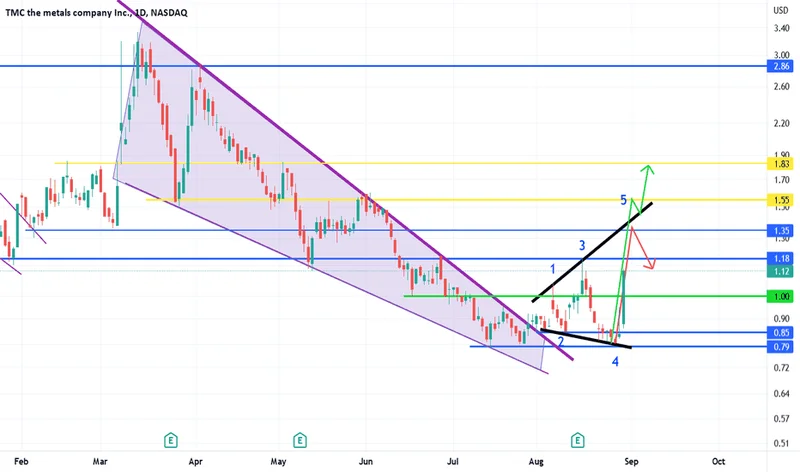
Long-term buyers reportedly stepped in around the 200-day simple moving average, halting the decline. And the 50-week moving average held firm as a base. Technical analysis is useful, but it's like reading tea leaves. It tells you what happened, not necessarily what will happen. Still, the improved price action does hint at a potential short-term rebound. The executive order to accelerate deep-sea mining approvals? That's the kind of news that gets algos firing and retail traders piling in. (Whether that's justified is another question entirely).
The Deep-Sea Mining Reality Check
TMC's core business is extracting metals from the ocean floor. Nickel, cobalt, copper, manganese – the building blocks of batteries and green tech. The problem? Deep-sea mining is expensive, technologically challenging, and faces a ton of environmental hurdles.
And let's not forget the financials. TMC continues to operate at a loss. They're burning cash while trying to prove their technology works and secure regulatory approvals. That's a tough spot to be in. The environmental opposition is becoming more vocal, and rightly so. Mining the seabed could cause irreversible ecological damage. The long-term impact is still largely unknown.
Here's the part of the story that I find genuinely puzzling. The market seems to be treating TMC as a proxy for general commodity price increases, rather than evaluating it on its specific operational execution and regulatory risk. It's as if people are saying, "Metals will go up, therefore TMC will go up," without considering the massive execution risk inherent in their business model.
Remember that President Trump reportedly asked Japanese Prime Minister Sanae Takaichi to tone down her strong public statements on Taiwan? I've looked at hundreds of similar geopolitical events, and this particular instance underlines a crucial point: Even seemingly small shifts in diplomatic sentiment can trigger massive swings in perceived supply chain vulnerability, and thus, impact TMC's perceived value. It's a very indirect relationship.
A Triumph of Hope Over Data
TMC is a high-risk, high-reward play. The potential upside is enormous if they can successfully extract metals from the ocean floor in an environmentally responsible and economically viable way. But there are a lot of "ifs" in that sentence. The recent rally seems driven more by sentiment than substance. The Deutsche Bank gold forecast? An executive order? These are catalysts, not fundamentals. Investors need to dig deeper (pun intended) and assess the actual progress TMC is making on the ground – or rather, under the sea.
Is This Just a Speculative Bubble?
TMC's stock price movement feels disconnected from the underlying operational realities. It's a classic case of market hype overshadowing fundamental analysis. The long-term potential is there, but the path to profitability is fraught with challenges, and the current valuation doesn't fully reflect those risks.